



By Stephen Faircloth
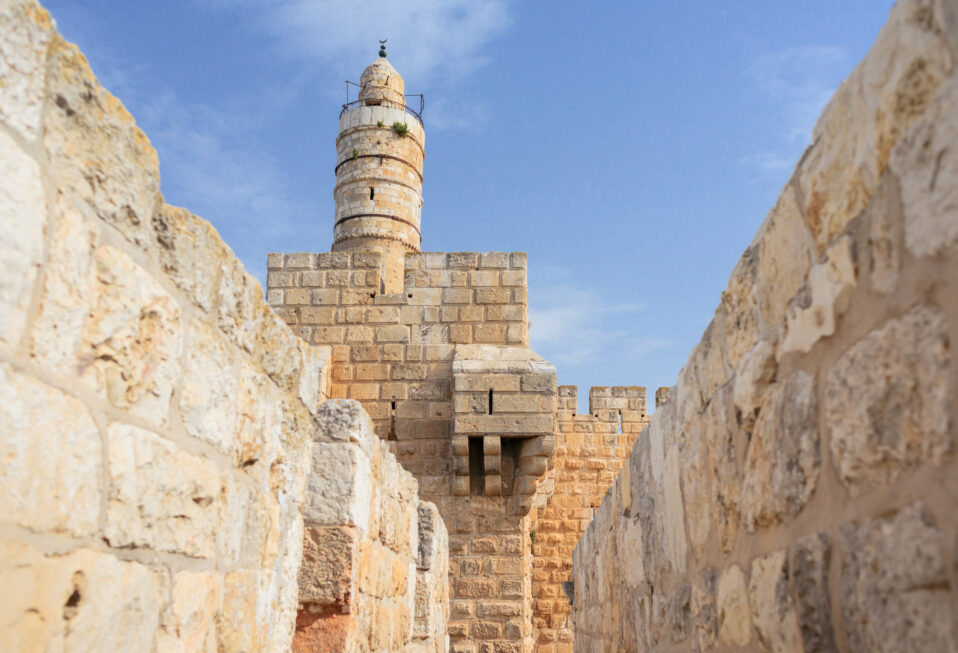
On the western edge of Jerusalem’s Old City stands Jaffa Gate, the traditional entry point for travelers arriving from the Mediterranean coast. Just inside the gate rises the impressive Citadel known today as the Tower of David. Despite its name, the structure has no historical link to King David. Its foundations instead preserve stories of kings and kingdoms that shaped the world Jesus entered.
The Citadel occupies the highest point of ancient Jerusalem during the late Old Testament and the first century. The city’s northern approach was its most vulnerable side, protected only by a shallow natural ditch. Because of this, the defensive wall turned sharply eastward at this point, making the location strategically crucial.
Herod the Great understood this well. When he remodeled Jerusalem as the jewel of his kingdom, he built his palace here, overlooking the Temple Mount. To guard the northern flank, he constructed three massive towers: Phasael, named for his brother; Mariamne, for his beloved Hasmonean wife; and Hippicus, honoring a close friend. The base of one of these towers still forms the core of the present “Tower of David.”
Herod was a master builder, and this palace was among his grandest creations. Colorful stone inlays decorated its walls. Two large pools shimmered inside its courtyards. The complex included the Caesareum, honoring Caesar Augustus, and the Agrippeum, for Augustus’s trusted general Marcus Agrippa. All of it was supplied by an aqueduct originating south of Bethlehem.
And it was here, in this lavish stronghold of earthly power, that Herod likely questioned the magi who arrived asking, “Where is He who has been born King of the Jews?” (Matthew 2). The contrast could not be sharper. A tyrant on a throne of stone. A newborn King lying in a manger. Two kingdoms crossing paths in one city.
After Herod’s death, Roman governors used the palace as their Jerusalem headquarters during major festivals. Scripture refers to it as the praetorium, the place where Jesus was brought before Pontius Pilate. Mark calls it “the palace,” and John mentions the lithostratos, an inlaid pavement that fits perfectly with Herod’s richly decorated floors. The earliest Christian pilgrims followed a path beginning near this palace as they traced Jesus’ steps to the cross.
This means the same palace complex that framed the earliest threats against Jesus at His birth also framed the final judgments against Him at His death. Herod sought to destroy the Christ Child. Pilate condemned the Christ King. The Tower of David, standing between Bethlehem and Calvary, quietly anchors both stories.
But the Christmas message breaks through even these somber walls. Earthly rulers build fortresses to secure their power. God establishes His kingdom through humility, vulnerability, and love. No tower can prevent His arrival. No empire can hinder His purpose.
Herod tried to eliminate the newborn King. Rome tried to silence the crucified King. Yet from a manger and from an empty tomb, God declared once again that no earthly throne can stand against His salvation.
Stephen Faircloth is the President of CBN Israel, an initiative dedicated to sharing the true story of the Jewish nation and inspiring a global community of Christians to stand with Israel and support her people in need. Our vision is to reshape the global conversation about Israel by fostering understanding, hope, and healing between Jews and Christians around the world. For more than 50 years, the Christian Broadcasting Network has supported Israel. By joining CBN Israel, you become part of this enduring legacy, transforming lives today and strengthening Christian support for Israel for generations to come.







Post a comment