



By Stephen Faircloth
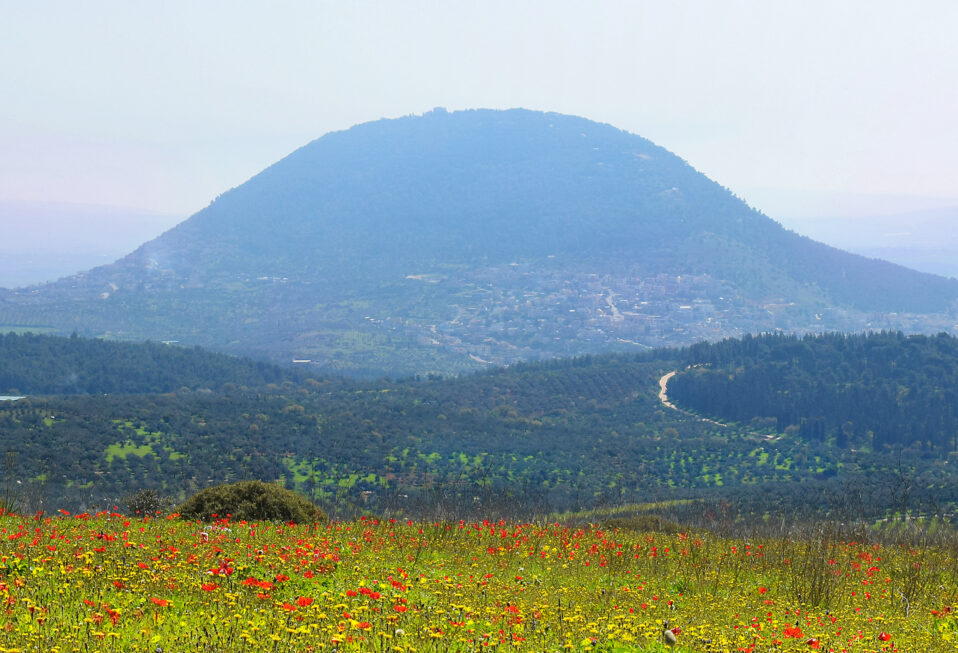
Rising from the northeastern edge of the Jezreel Valley, Mount Tabor stands alone, its rounded shape visible from great distances. Unlike the surrounding hills, it rises abruptly from the valley floor, its steep slopes leading to a broad plateau at the summit measuring roughly one thousand meters by four hundred meters. This solitary mountain marked the meeting point of the tribal territories of Zebulun, Issachar, and Naphtali, placing it at both a geographic and symbolic crossroads within ancient Israel.
Mount Tabor entered the biblical story most clearly during the time of the judges. Deborah and Barak gathered the Israelite forces on this mountain before facing the Canaanite army led by Sisera, the general of Jabin king of Hazor. The choice of Tabor was strategic. The steep slopes limited the effectiveness of Sisera’s iron chariots, which required flat terrain to maneuver. From this elevated position, the Israelites descended to meet the enemy, turning the landscape itself into an instrument of deliverance. The victory celebrated in Judges 4 and 5 became a testimony to how God used both faith and geography to bring freedom to His people.
Beyond military strategy, Mount Tabor may also have held religious significance. Biblical passages suggest that the mountain was associated with worship and pilgrimage, which may explain why the tribes gathered there before battle. It was a place where allegiance to God was affirmed before action was taken. In this way, Mount Tabor functioned not only as a stronghold but also as a place of decision, where trust in God preceded victory.
In later centuries, Mount Tabor continued to play a role in the region’s history. During the Hellenistic and Roman periods, it served as the site of several conflicts. Josephus records that he fortified the mountain during the First Jewish Revolt against Rome, recognizing once again its defensive advantages. Even in these later struggles, Mount Tabor remained a place where power, resistance, and survival intersected.
Christian tradition eventually turned its attention to Mount Tabor as well. From an early period, some believers identified it as the possible location of the Transfiguration of Jesus. The Gospels describe the event as taking place on a very high mountain but do not name it. Early sources, including quotations preserved by Church Fathers such as Origen and Cyril, associate the Transfiguration with Mount Tabor. If this tradition reflects material from the late first or early second century, it shows how early Christians sought to anchor moments of divine revelation within the physical landscape of the Holy Land.
At the same time, not all early Christian pilgrims treated Mount Tabor as a sacred site. Writers like Eusebius and the Bordeaux Pilgrim do not single it out in their accounts. This suggests that while the tradition existed, it was not universally emphasized in the early Byzantine period. Over time, however, devotion grew, and today a church crowns the summit, marking the mountain as a place of reflection and remembrance.
Mount Tabor reminds us that God often meets His people in elevated places, both literally and spiritually. It was a mountain of battle, of worship, and possibly of revelation. Whether in moments of conflict or moments of glory, it stands as a reminder that God acts within real places and real history. The same God who brought victory through Deborah and Barak, and who revealed His glory to the disciples, still calls His people to trust Him when standing at the heights of decision and faith.
Stephen Faircloth is the President of CBN Israel, an initiative dedicated to sharing the true story of the Jewish nation and inspiring a global community of Christians to stand with Israel and support her people in need. Our vision is to reshape the global conversation about Israel by fostering understanding, hope, and healing between Jews and Christians around the world. For more than 50 years, the Christian Broadcasting Network has supported Israel. By joining CBN Israel, you become part of this enduring legacy, transforming lives today and strengthening Christian support for Israel for generations to come.





Post a comment