



By Stephen Faircloth
Roadways are among the most important features of biblical geography. They shaped where people lived, how cities developed, and who controlled trade and communication. To control a road was to control movement, influence, and power. Many biblical events unfolded not by accident, but because of where those roads led. When we overlook the geography, we often miss part of the story.
Jerusalem in the Old Testament period did not sit directly on a major international highway. The primary north-south route through the central hill country ran west of the city. Steep valleys and rugged terrain made direct access from east and west difficult. For that reason, the region of Benjamin just north of Jerusalem became crucial. It functioned as a crossroads where major routes converged. Anyone traveling east or west from Jerusalem first moved north to connect with those roads. Geography shaped opportunity.
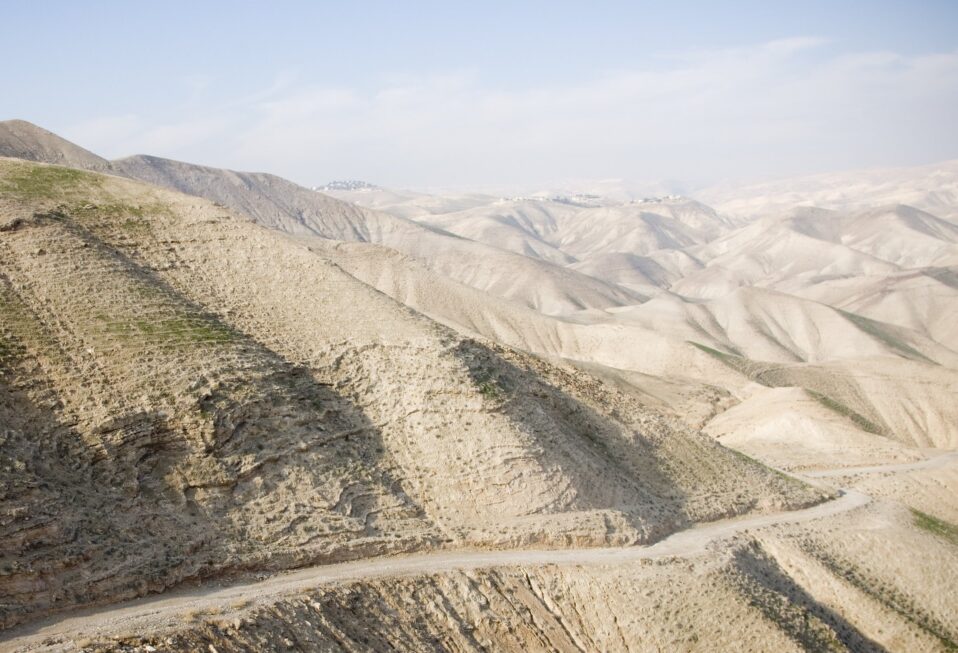
By the New Testament period, however, Jerusalem’s prominence required better access to the Jordan Valley. A road developed between Jerusalem and Jericho, roughly twenty-three miles apart. The journey was dramatic. From about 2700 feet above sea level in Jerusalem, the road descended to nearly 850 feet below sea level at Jericho. Travelers moved from cool hill country to arid wilderness in a single day. The path wound through a canyon system east of Jerusalem, the largest branch known as Wadi Qilt.
Wadi Qilt carved a rugged corridor through the Judean wilderness. Its steep cliffs and narrow passes offered both shelter and danger. At its eastern mouth near Jericho stood Herod the Great’s winter palace. Josephus records that Herod died there in 4 B.C. His palace complex straddled the wadi, and he diverted its water to fill pools and baths, a display of luxury in the midst of desert barrenness.
This was not an obscure path. Jesus Himself likely traveled this route. Galilean pilgrims often journeyed south along the Jordan River, crossed near Jericho, and then ascended to Jerusalem through the canyon. When Luke records Jesus telling the story of a man “going down from Jerusalem to Jericho,” He places the parable within this very terrain. The winding road, isolated stretches, and rocky hiding places made it believable that robbers could strike. The Good Samaritan story is rooted in real geography.
The road through Wadi Qilt reminds us that God’s purposes often unfold along difficult paths. Pilgrims walked this descent and ascent to worship at the Temple. They passed royal palaces, harsh wilderness, and dangerous turns. Yet the road led to encounter with God.
Our own lives follow similar terrain. We travel through high places and low valleys, through stretches that feel exposed and uncertain. At times the descent is steep and the wilderness dry. But the road still leads somewhere. The God who met pilgrims on that ancient path meets us on ours.
Biblical geography teaches us that location matters. So does direction. The question for us is not whether the road is easy, but whether it leads toward faithfulness. Even through wilderness canyons, God guides His people upward toward His presence.
Stephen Faircloth is the President of CBN Israel, an initiative dedicated to sharing the true story of the Jewish nation and inspiring a global community of Christians to stand with Israel and support her people in need. Our vision is to reshape the global conversation about Israel by fostering understanding, hope, and healing between Jews and Christians around the world. For more than 50 years, the Christian Broadcasting Network has supported Israel. By joining CBN Israel, you become part of this enduring legacy, transforming lives today and strengthening Christian support for Israel for generations to come.





Post a comment