



By Stephen Faircloth
After sharing the Passover meal in Jerusalem, Jesus left the city with His disciples and went to a place called Gethsemane (Matthew 26:36; Mark 14:32). While the exact location cannot be identified with certainty, the Gospels make clear that it was on the Mount of Olives, just across the Kidron Valley from Jerusalem (Luke 22:39; John 18:1).
During Passover, pilgrims would eat the meal within the city, but many stayed outside its walls on the surrounding hillsides. The Mount of Olives, with its groves of trees, provided a natural place to gather, rest, and pray. It was here, away from the crowds but still within sight of the city, that Jesus often withdrew with His disciples.
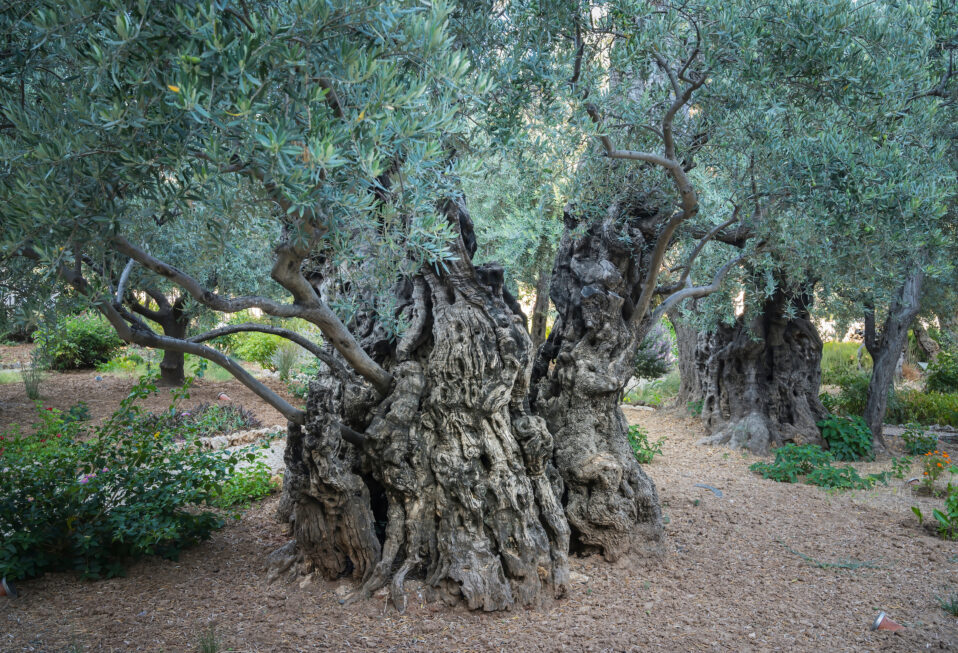
The name Gethsemane likely comes from Hebrew words meaning “oil press.” This suggests the area was associated with the production of olive oil, fitting for a place on the Mount of Olives. The imagery is striking. Just as olives are pressed to produce oil, Jesus entered a place where He Himself would be pressed under the weight of what lay ahead.
Today, visitors to Jerusalem can walk among olive groves on the Mount of Olives and reflect on this moment. While traditions point to several possible locations, the precise spot matters less than what happened there. The setting itself helps us understand the depth of Jesus’ experience.
Beyond the ridge of the Mount of Olives, the land drops sharply into the wilderness that stretches toward Jericho and the Dead Sea. This rugged terrain has long provided refuge for those seeking to disappear. From where Jesus prayed, escape was not far away. Within a short time, He could have fled into the wilderness and avoided what was coming.
That reality gives new weight to His prayer: “Father, if You are willing, take this cup from Me; yet not My will, but Yours be done” (Luke 22:42).
Jesus was not trapped. He was not forced. He stood at a place where He could choose another path. Yet He willingly turned away from escape and toward obedience. He chose the Father’s will, even though it led to suffering and the cross.
Gethsemane reminds us that surrender is often a choice made in moments of deep struggle. It is not always easy or painless. It may involve facing what we would rather avoid. But it is in those moments that true trust is revealed.
We all encounter our own “Gethsemane” places, moments when we must choose between our will and God’s. Sometimes the easier path lies within reach. Sometimes obedience feels costly. Yet Jesus shows us what it means to trust the Father fully.
He chose obedience, knowing that beyond the suffering lay redemption.
As we reflect on Gethsemane, we are invited to consider our own response. Will we trust God when the path is difficult? Will we surrender our will to His, even when we do not fully understand?
The same God who strengthened Jesus in that moment walks with us in ours.
Stephen Faircloth is the President of CBN Israel, an initiative dedicated to sharing the true story of the Jewish nation and inspiring a global community of Christians to stand with Israel and support her people in need. Our vision is to reshape the global conversation about Israel by fostering understanding, hope, and healing between Jews and Christians around the world. For more than 50 years, the Christian Broadcasting Network has supported Israel. By joining CBN Israel, you become part of this enduring legacy, transforming lives today and strengthening Christian support for Israel for generations to come.





Post a comment