



By Stephen Faircloth
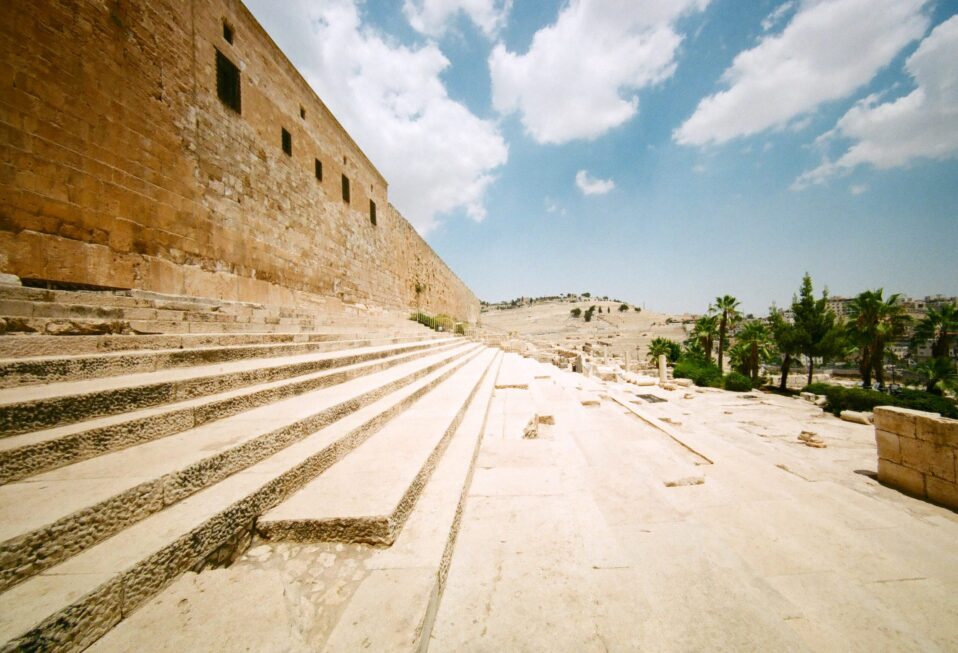
In the days of the Second Temple, pilgrims approaching Jerusalem did not rush casually into the presence of God. Their journey reached its most sacred moment on the southern side of the Temple Mount. After ritually purifying themselves, either at the Pool of Siloam or in one of the many immersion baths clustered near the Temple Mount, worshipers began their ascent up the broad southern steps. These steps led through the Huldah Gates, the main entrances for pilgrims entering the Temple complex.
Passing through the gates, worshipers entered a covered hall that guided them through an ascending tunnel. When they emerged, they stood on a beautifully paved plaza at the southern end of the Temple Mount, directly facing the sacred courts and the Temple itself. The transition was intentional. Pilgrims moved from the ordinary world into a space set apart, preparing their hearts as well as their bodies to encounter the presence of God.
The southern steps themselves speak a quiet lesson. They were constructed in a deliberate pattern of long and short steps, making it nearly impossible to hurry upward. Each step required attention and care. This design slowed the pilgrim’s pace, encouraging reflection and reverence. One could not rush into the house of the Lord. Worship demanded intention, humility, and awareness.
The flow of pilgrims through the gates also reflected compassion woven into worship. Those who entered rejoicing followed one path, while those who were mourning entered through the opposite gate. This reversal allowed others to recognize their grief and offer comfort. As they passed, fellow worshipers would speak words of consolation, reminding them that the God who dwelled in the Temple was also the God who brought comfort to the brokenhearted.
Teachers and sages often sat on these steps, engaging pilgrims in conversation and instruction. These steps were not only a place of movement but also a place of learning, reflection, and community. Faith was formed not only inside the Temple courts but also along the way.
Today, visitors can still see portions of these ancient steps. Though many have been reconstructed, some original stones remain, worn smooth by countless feet. Nearby, archaeologists uncovered large ritual immersion baths that served both priests and pilgrims, further emphasizing the seriousness with which worshipers prepared themselves to approach the Temple of God.
The southern steps remind us that drawing near to God is a journey that shapes us. Preparation matters. Pace matters. Reverence matters. God invites us to come close, but He also calls us to do so thoughtfully, with hearts ready to worship and lives open to His presence.
Stephen Faircloth is the President of CBN Israel, an initiative dedicated to sharing the true story of the Jewish nation and inspiring a global community of Christians to stand with Israel and support her people in need. Our vision is to reshape the global conversation about Israel by fostering understanding, hope, and healing between Jews and Christians around the world. For more than 50 years, the Christian Broadcasting Network has supported Israel. By joining CBN Israel, you become part of this enduring legacy, transforming lives today and strengthening Christian support for Israel for generations to come.





Post a comment