



By Stephen Faircloth
Nazareth, the hometown of Jesus, rests quietly on the Nazareth Ridge in the Lower Galilee. From its limestone heights, the village overlooks the sweeping Jezreel Valley to the south and the fertile Beit Netofa Valley to the north. Though small and unassuming, Nazareth occupies a remarkable place in the story of God’s redemption.
The New Testament gives Nazareth its first mention (Matthew 2:23; Luke 1:26), telling us that Mary lived there and that Joseph brought his family back to Nazareth after their return from Egypt. It is in this humble village that Jesus grew up, learned His earthly trade, worshiped at the synagogue, and began to be known as “Jesus of Nazareth” (Matthew 21:11). Luke also records how Jesus read from Isaiah in the Nazareth synagogue and declared the Scripture fulfilled in their hearing, provoking strong reactions (Luke 4:16-30).
Although few earlier written sources mention Nazareth, archaeology reveals that the area had been occupied for centuries. Excavations show evidence from the Middle Bronze Age through the Iron Age II, and into the Hellenistic and early Roman periods. Tombs discovered from the first century B.C. through the first century A.D. mark the village’s boundaries, since Jewish burial practices required tombs to lie outside inhabited areas. From these finds, scholars estimate that Nazareth in Jesus’ day covered roughly sixty acres and housed perhaps five hundred people.
Nazareth was not isolated. Only 3.8 miles north stood Sepphoris, the capital of Galilee during Jesus’ youth. The close proximity suggests that the people of Nazareth interacted economically and culturally with a major urban center. Moreover, Nazareth’s location between two valleys that carried international trade routes means Jesus likely grew up hearing many languages and seeing travelers from across the region. His early life unfolded not in obscurity but in a village that stood near the crossroads of cultures.
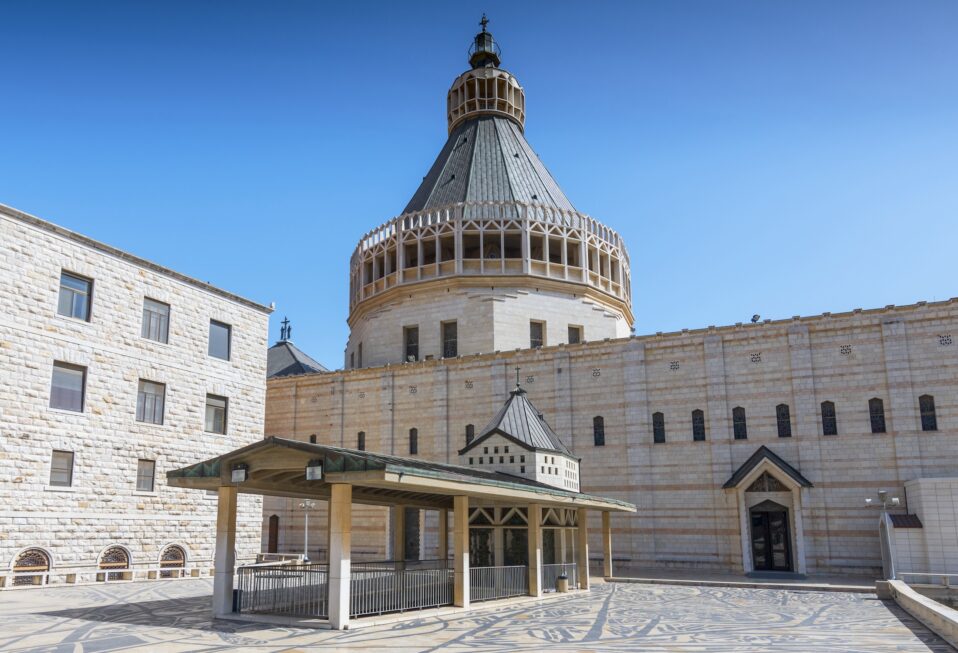
Archaeologists have uncovered what may be a Jewish ritual immersion bath from the early Roman period, a discovery that could point to the location of Nazareth’s synagogue. This site, along with early Christian remains, lies within the modern Basilica of the Annunciation, completed in the 1960s. According to later Jewish tradition, the priestly family of Hapizez settled in Nazareth after the destruction of the Temple in A.D. 70, a detail confirmed by an inscription from Caesarea.
By the fourth century A.D., Christian pilgrims were already making their way to Nazareth. They were shown a cave believed to be the home of Mary, a place long venerated and continuously honored with churches from the Byzantine era onward. Today, Nazareth remains a major pilgrimage site anchored by two historic churches: the Catholic Basilica of the Annunciation and the Greek Orthodox Church built over the ancient spring.
Nazareth teaches us something profound about the ways of God. He often chooses what is small, quiet, and easily overlooked to carry out His greatest work. The Messiah emerged not from a royal city or cultural capital but from a humble Galilean village. God’s purposes often grow in hidden places, taking shape long before the world takes notice.
What places or seasons in your life feel small or overlooked? Nazareth reminds us that God delights in working through humble beginnings to accomplish extraordinary purposes.
Stephen Faircloth is the President of CBN Israel, an initiative dedicated to sharing the true story of the Jewish nation and inspiring a global community of Christians to stand with Israel and support her people in need. Our vision is to reshape the global conversation about Israel by fostering understanding, hope, and healing between Jews and Christians around the world. For more than 50 years, the Christian Broadcasting Network has supported Israel. By joining CBN Israel, you become part of this enduring legacy, transforming lives today and strengthening Christian support for Israel for generations to come.





Post a comment