



By Arlene Bridges Samuels
A digital war is being waged against Israel. Iran, Hamas, and other hostile actors employ cyber espionage, phishing schemes, malware, and attacks on infrastructure as part of their campaign to undermine and delegitimize the Jewish state.
Social media has become both a battlefield and a tool in this struggle. While it can spread misinformation quickly, it can also serve as a powerful platform for truth. The challenge is separating fact from falsehood. In response, the Israel Antiquities Authority has launched an innovative project that uses the digital world to reveal undeniable evidence of Israel’s ancient roots.
Last September, the Israel Antiquities Authority introduced the Israel National Archaeological Database, a free online resource available to scholars, students, journalists, and the general public. The database opens a vast window into the past.
Visitors are welcomed with an invitation to “jump into the past with one click.” It is the largest archaeological database of its kind in the world. The scope of the collection is remarkable. It contains nearly 3.9 million records, almost one million artifacts, more than 1.2 million images, and over 15,000 three dimensional models of sites and discoveries. Approximately 2,000 researchers maintain and expand the database.
Beyond its academic value, this digital treasure trove provides an important tool for anyone seeking to counter misinformation about Israel. The database allows users to quickly locate photographs, descriptions, and documentation that demonstrate the deep historical connection between the Jewish people and the land of Israel. In an era when false claims circulate rapidly online, verifiable archaeological evidence offers a powerful response.
Free public access makes the database especially valuable. For years, Palestinian groups have removed artifacts from archaeological sites in attempts to erase or distort Jewish history. In some cases, international institutions have even adopted narratives that diminish Jewish ties to sacred locations. At the urging of the Palestinian Authority, the United Nations Educational, Scientific and Cultural Organization renamed the Temple Mount and the Western Wall using only Arabic terminology.
In addition, hundreds of truckloads of soil containing ancient artifacts were removed from beneath the Temple Mount without proper archaeological supervision. Such actions threaten the preservation of priceless historical evidence. The Israel National Archaeological Database, along with enhanced protections for archaeological sites, helps safeguard the historical record and ensures that discoveries are properly documented.
Archaeology provides physical evidence of Israel’s ancient past. Each artifact uncovered from the soil tells a story about the people who lived there thousands of years ago. These discoveries confirm that the land of Israel has been the ancestral homeland of the Jewish people for millennia.
Since Israel’s rebirth as a modern state in 1948, archaeological research has expanded dramatically. New discoveries are made almost every year. By studying and sharing these findings, individuals can help counter misinformation and provide reliable historical context in a world often clouded by anti-Israel narratives.
Alby Malka, head of the Technologies Division at the Israel Antiquities Authority, explains the rigorous standards behind the process. “By Israeli law, every archaeological find that is uncovered must be reported, documented, and deposited in the National Archives.” Each item is carefully cataloged, labeled, photographed, and preserved. The result is a vast collection of ancient scrolls, coins, pottery, jewelry, and architectural remains that illuminate Israel’s past.
Malka describes the database as “a tool of paramount importance for scientific research, for preserving the country’s heritage, and for deepening public knowledge.” The project represents a major step forward that places Israel at the forefront of global archaeological research.
Eli Escusido, director of the Israel Antiquities Authority, emphasizes the broader significance of the effort. “This database reflects the great wealth of archaeological research carried out here, since this land has been a crossroads of human history.” He adds that the authority views itself as the guardian of the heritage of every culture and faith that has lived in the region. Preserving that legacy is both a moral responsibility and a legal mandate.
Many of the artifacts in the database provide direct testimony to the ancient Jewish presence in the land. Sometimes discoveries occur in unexpected ways. Children walking along a trail may find a two-thousand-year-old coin engraved with a menorah. At other times, construction projects reveal remarkable finds.
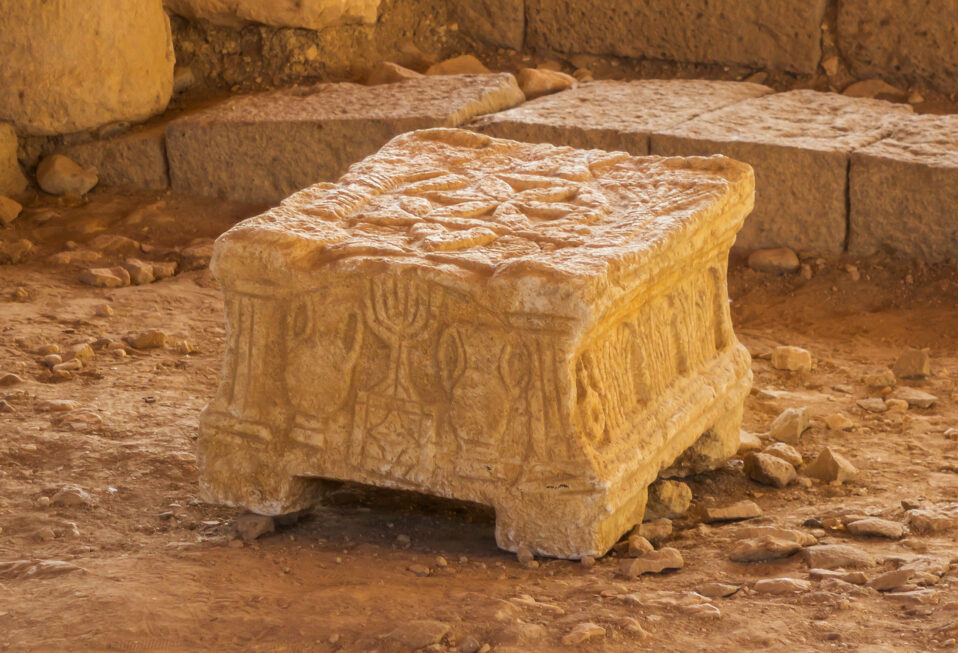
One such discovery occurred in 2009 near the Sea of Galilee. During construction work on Migdal Beach, workers uncovered the remains of a synagogue from the Second Temple period. Archaeologists called to the site discovered a carved limestone block with a beautifully engraved menorah. The artifact, now known as the Magdala Stone, is considered one of the most important archaeological discoveries in modern Israel. Scholars believe the artist who carved the menorah may have personally seen the golden menorah that once stood in the Temple in Jerusalem. Today, Magdala has become one of the most visited archaeological and spiritual sites in the region.
Another remarkable discovery emerged in Jerusalem in 2004. Workers repairing a street uncovered an opening that revealed an ancient stone roadway beneath the modern city. Excavations revealed the Pilgrim Road, a first century street built of massive limestone slabs. The road stretches approximately 1,760 feet and measures about twenty-six feet wide. It connects the Pool of Siloam to the Temple Mount.
After more than a decade of careful excavation and preservation, the Pilgrim Road opened to visitors in early 2026. In ancient times, Jewish pilgrims walked this road three times each year during the biblical festivals of Passover, Weeks, and Tabernacles. As they ascended toward the Temple, they sang the Psalms of Ascents found in Psalms 120 through 134. Today, visitors walking this path experience a tangible connection with the faith and history that shaped the land.
Archaeology continues to uncover the physical record of Israel’s past. Each discovery strengthens our understanding of the ancient world and confirms the deep historical roots of the Jewish people in their homeland.
The Israel National Archaeological Database now makes these discoveries accessible to anyone with an internet connection. In a digital age filled with misinformation, this remarkable resource provides a powerful reminder that history is not merely written in books. In Israel, it is literally written in stone.
Our CBN Israel team invites you to join us in prayer during this important season.
Prayer Points:
- Pray for the success of the new archaeological database as it informs the world about Israel’s historical record.
- Pray that journalists and media outlets will seek and report accurate information.
- Pray for protection of archaeological sites from theft and destruction.
- Pray for volunteers and researchers who participate in archaeological excavations throughout Israel.
Arlene Bridges Samuels is the weekly feature columnist for CBN Israel since 2020. Working on the staff of the American Israel Public Affairs Committee (AIPAC) as their SE Regional Outreach Director for nine years, International Christian Embassy Jerusalem USA engaged her as the Leadership Outreach Director part-time for their project American Christian Leaders for Israel. Arlene is an author at The Blogs-Times of Israel, is published at AllIsrael.com and The Jerusalem Connection, and has traveled to Israel since 1990. By invitation, she attends Israel’s Government Press Office Christian Media Summits as part of Christian media worldwide. In 2024, Arlene and her husband Paul co-authored Mental Health Meltdown: Illuminating the Voices of Bipolar and Other Mental Illnesses. www.TheMentalHealthMeltdown.com.







Post a comment