



By Stephen Faircloth
Beth Shean sits at one of the most strategic locations in the land of Israel. Positioned where major roads intersected, it connected the Jezreel and Harod Valleys with the Jordan River Valley and the regions beyond. Because of this, people, armies, and ideas continually passed through it. Its location made it a place of influence, but also a place of constant change.
For thousands of years, Beth Shean was inhabited. Empires recognized its importance. Egypt once ruled from here, establishing it as an administrative center. Later, during the Greek and Roman periods, it became a thriving city known as Scythopolis. Its story reflects the rise and fall of kingdoms, each leaving its mark on the land.
Yet Beth Shean also carries a sobering place in the biblical story.
Although it was allotted to the tribe of Manasseh, the Israelites were never able to fully take control of the city. Its inhabitants, equipped with advanced military strength, held their ground. This detail reminds us that not every promise was immediately realized, especially when fear or limitation stood in the way.
One of the most haunting moments connected to Beth Shean comes after the death of King Saul. Following his defeat on Mount Gilboa, the Philistines displayed the bodies of Saul and his sons on the walls of the city. It was a moment of deep humiliation and grief for Israel. Yet even in that dark moment, men from Jabesh Gilead acted with courage, retrieving the bodies and giving them a proper burial.
Beth Shean, therefore, becomes a place where we see both defeat and devotion, loss and loyalty.
By the time of Jesus, the city was largely Gentile, and the Gospels do not record Him ministering there directly. Yet the region still formed part of the landscape He moved through. As He journeyed toward Jerusalem, He passed near areas shaped by the same roads and valleys that gave Beth Shean its importance.
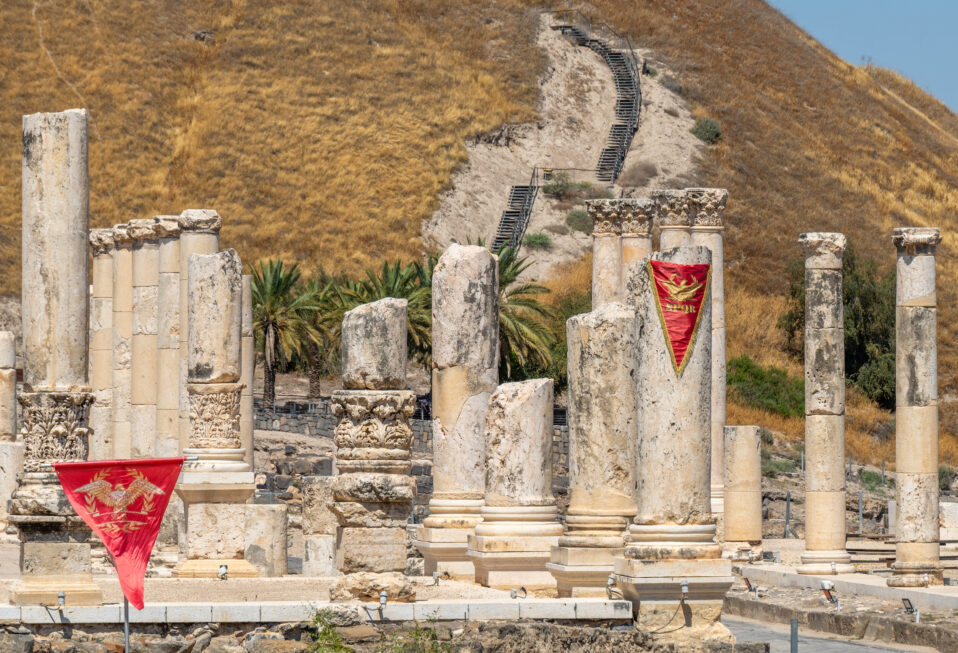
Today, visitors to Beth Shean see the remains of a grand Roman city, with theaters, bathhouses, and colonnaded streets. But above it rises the ancient mound, the tel, where earlier civilizations once stood. The layers of the site tell a story of time, transition, and human ambition.
Beth Shean invites us to reflect on our own lives.
Like this city, we often find ourselves at crossroads. Places of decision. Moments where paths intersect and choices must be made. Sometimes those places bring opportunity. Other times they reveal our limitations or remind us of past failures.
Yet God is present in every season.
The story of Beth Shean reminds us that even in places marked by defeat, God’s purposes are not undone. Even in moments of loss, there are acts of faithfulness that matter. And even when we stand at uncertain crossroads, God continues to guide those who trust Him.
Where are you standing today? At a place of decision? A place of uncertainty? Or perhaps a place marked by past struggles?
Beth Shean reminds us that history does not define our future. God does. And at every crossroads, He invites us to trust Him and walk forward in faith.
Stephen Faircloth is the President of CBN Israel, an initiative dedicated to sharing the true story of the Jewish nation and inspiring a global community of Christians to stand with Israel and support her people in need. Our vision is to reshape the global conversation about Israel by fostering understanding, hope, and healing between Jews and Christians around the world. For more than 50 years, the Christian Broadcasting Network has supported Israel. By joining CBN Israel, you become part of this enduring legacy, transforming lives today and strengthening Christian support for Israel for generations to come.





Post a comment