

By Arlene Bridges Samuels
The word “brotherhood” often reflects fellowship, loyalty, and shared purpose among men united by common goals, beliefs, or professions. In Christian communities, these can be constructive and welcome concepts. However, a dangerous version of brotherhood aimed at destructive goals has become deeply entrenched in the United States. It is the Muslim Brotherhood.
In a 1991 memorandum later uncovered during an FBI raid, the Muslim Brotherhood outlined its strategy to infiltrate America’s political, academic, and social institutions. One phrase from that document says it all: “The plan to take down democracy without firing a shot.” Keep that sentence in mind.
Since the Muslim Brotherhood’s arrival in the United States in the 1950s, its goals have expanded through schools, universities, chaotic demonstrations, media, and government institutions at the federal, state, and local levels. A 2025 study prepared for the Department of Homeland Security and Congress traced how the world’s oldest and most influential Islamist movement gained a foothold in the United States.
Congress is now actively considering legislation to designate the Muslim Brotherhood as a terrorist organization. Such a designation would criminalize material support, freeze assets, restrict visas and immigration, and increase federal scrutiny of affiliated organizations. The bipartisan bill introduced in 2025 is still moving through Congress, and President Trump has issued an executive order directing the U.S. Treasury and State Department to designate Muslim Brotherhood branches in Egypt, Jordan, and Lebanon as Foreign Terrorist Organizations.
A look at both history and current events should alert members of Congress and American citizens to the importance of understanding the Muslim Brotherhood and responding accordingly. Founded nearly one hundred years ago in Egypt, the Muslim Brotherhood has influenced the Middle East, Israel, Iran, Europe, and the United States. It was established in 1928 by religious scholar and schoolteacher Hassan al-Banna, who believed Muslim religion and culture were under threat.
After World War I, Britain had gained strong colonial influence in Egypt, and in 1924 the Ottoman Empire was abolished. For four hundred years, that caliphate had exercised authority over vast territories, including Islam’s holiest cities of Mecca and Medina, while also claiming Jerusalem.
Al-Banna’s solution was to unite religion and state under Sharia, Islamic law, with the slogan, “Islam is the solution.” What began inconspicuously under one man has expanded into a global Islamist movement. Its quieter underbelly in the United States began under the cover of cultural and student organizations.
Understanding current facts about the Muslim Brotherhood helps Americans protect their homeland and stand wisely with Israel, our great ally.
In a recent podcast, Jonathan Feldstein, CEO of Genesis 123 Foundation, interviewed Emily Nielson Winkler, an expert on the Muslim Brotherhood. An Israeli American, Emily is CEO of VALOP, which stands for Vulnerability, Analysis, and Operations, a network of intelligence services working to expose and dismantle terrorist organizations. Her organization investigates how Islamist alliances organize, fund, recruit, and embed themselves inside Western systems. With exceptional intelligence and research skills, VALOP works to restore stability to communities damaged by radicalization and violence.
Emily’s insights were both authoritative and invaluable. She explained that the Muslim Brotherhood’s first major foothold in the United States was the Muslim Students Association, founded in 1963 at the University of Illinois Urbana-Champaign. The Brotherhood intentionally focused on college students, as it continues to do today, to recruit educated activists and shape political discourse.
She also emphasized that the Muslim Brotherhood is not a local or regional group. It is a large global entity that poses a global threat. It does not respect national borders, and sovereign nations are irrelevant to its mission. The Brotherhood is primarily a network of highly educated scholars, numbering in the hundreds of thousands worldwide, who believe the fall of the Ottoman Empire must be reversed.
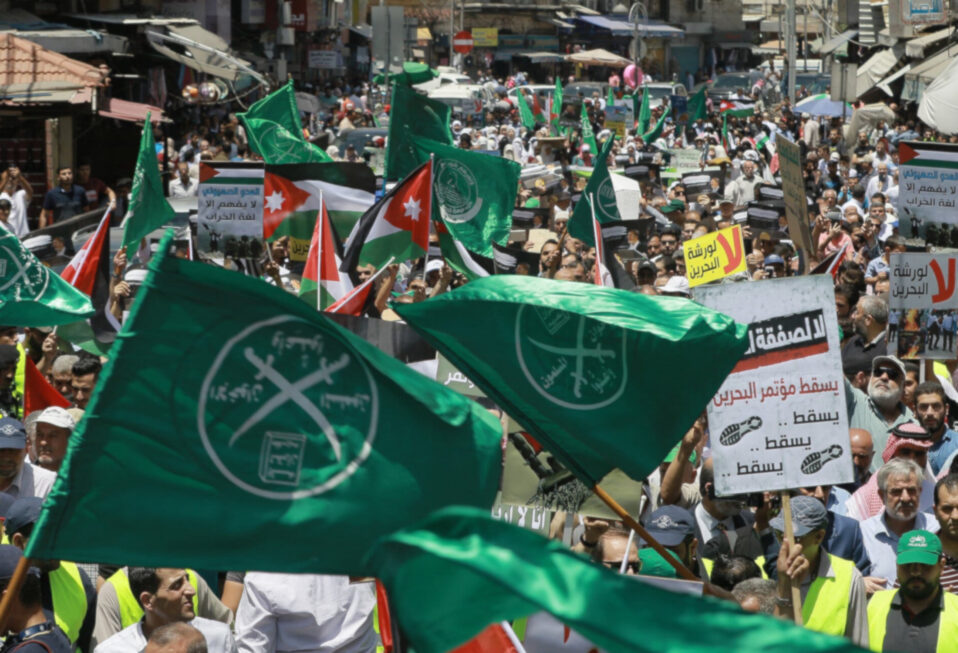
Emily reminded listeners that several prominent Arab nations have designated the Muslim Brotherhood as a terrorist organization or severely restricted it. Egypt has expelled or outlawed the movement multiple times. Jordan has moved to seize Muslim Brotherhood assets. The United Arab Emirates and Saudi Arabia have strictly outlawed the Brotherhood. One of Winkler’s most striking observations is that the Muslim Brotherhood has become one of the Middle East’s biggest exports into Western nations. Expelled or restricted in many Arab countries, its members often relocate to the West.
Emily also clarified an essential distinction between Muslims and Islamists. Muslims are followers of the religion of Islam. Islamists, by contrast, follow a political ideology that seeks to replace existing governments with Islamist rule. Although Iran’s Islamic Regime is not organizationally part of the Muslim Brotherhood, it is an important example of a regime that seeks to impose Sharia wherever possible and destroy those who stand in its way.
Emily described Jews as the canary in the coal mine, warning that rising antisemitism often signals the early stages of broader societal takeover. “Once Jews have left, there’s nothing standing between the Muslim Brotherhood and you,” she warned.
Ephesians 5:11 is instructive here: “Have nothing to do with the fruitless deeds of darkness, but rather expose them.”
VALOP describes the Brotherhood’s tactics in the United States and other Western nations as six steps of escalation: educational indoctrination, organized mobilization, legalized harassment, criminal activity, terrorism, and finally societal capture.
Israel, the only democracy in the Middle East, is not alone in facing the consequences of Islamist ideology. Several Arab states are also under threat. Muslim Brotherhood ideology has destabilized the region for decades. Hamas is directly tied to the Brotherhood’s Palestinian branch. Hezbollah is an Iran backed Shia militia in Lebanon. The Houthis are funded, armed, and trained by Iran. The Islamic Regime’s 1979 revolution was shaped in part by Islamist ideology, and the Islamic Revolutionary Guard Corps cooperates with Brotherhood linked groups such as Hamas in strategic alliances.
How can everyday citizens respond? Emily suggests that Americans begin by asking questions of local and state leaders. Is the Muslim Brotherhood present in my community? Are local institutions receiving funds or influence from organizations connected to Islamist networks? Are schools, universities, or civic groups being used for indoctrination or recruitment?
Florida and Texas have already issued state level actions designating the Muslim Brotherhood as a terrorist threat. Although these do not carry the same weight as a federal designation, states can block Brotherhood connected individuals or entities from receiving state contracts, funds, or partnerships. Such actions can also trigger further legal and political scrutiny.
This broader context helps explain Israel’s daily reality. For Americans and citizens of other Western nations, Israel serves as an early warning signal. The Brotherhood’s long-term strategy seeks to reshape free societies from within. Ignoring that reality is dangerous. Heeding it is a matter of national vigilance and moral clarity.
Begin by asking questions in your town and state.
Our CBN Israel team welcomes you to join us in prayer this week.
Prayer Points:
- Pray for Christians to question local and state officials about the Muslim Brotherhood.
- Pray for awareness and vigilance among citizens regarding Islamist movements.
- Pray for cooperative wisdom for President Trump and Prime Minister Netanyahu.
- Pray for the IDF as its soldiers bravely protect their small nation.
Arlene Bridges Samuels is the weekly feature columnist for CBN Israel since 2020. Working on the staff of the American Israel Public Affairs Committee (AIPAC) as their SE Regional Outreach Director for nine years, International Christian Embassy Jerusalem USA engaged her as the Leadership Outreach Director part-time for their project American Christian Leaders for Israel (ACLI). Arlene is an author at The Blogs-Times of Israel, is published at AllIsrael.com and The Jerusalem Connection. Her devotionals and articles also appear on her Substack, The Eclectic Evangelical. She serves on the Advisory Board of NewPersia.org and on the advisory committee of RootAndBranchIsrael.com. Having traveled to Israel regularly since 1990, Arlene participates in Israel’s Government Press Office Christian Media Summits alongside members of Christian media from around the world. In 2024, Arlene and her husband Paul co-authored Mental Health Meltdown: Illuminating the Voices of Bipolar and Other Mental Illnesses. In May 2026, The White Rose Society honored Arlene as a non-Jewish individual who stands with the Jewish people.