

ARTICLES

Weekly Devotional: Who is My Neighbor?

“Just then an expert in the law stood up to test [Jesus], saying, ‘Teacher, what must I do to inherit eternal life?’ ‘What is written in the law?’ He asked him. ‘How do you read it?’ He answered: Love the Lord your God with all your heart, with all your soul, with all your strength, and with all your mind; and your neighbor as yourself. ‘You’ve answered correctly,’ He told him. ‘Do this and you will live’” (Luke 10:25-28 HCSB).

To Jesus’ reply, the lawyer followed up with the natural question, “And who is my neighbor?” In response, Jesus told the story of the Good Samaritan.

Have you ever noticed the nature of that question, “Who is my neighbor?” No matter how broad or narrow you make the circle, the question seeks to draw a line and define who’s inside and who’s outside of the line. Who are we obligated to love, and who are we relieved from loving? Jesus, however, turned the lawyer’s question around: “Which of these three do you think proved to be a neighbor to the man who fell into the hands of the robbers” (Luke 10:36)? In other words, it is not for us to define insider and outsider, but rather: We must go be the neighbor.

Jesus drew His inspiration for His teaching from God Himself. He recognized that God does not distinguish in His mercy, and neither can we. “But I tell you, love your enemies … so that you may be sons of your Father in heaven. For He causes His sun to rise on the evil and the good, and sends rain on the righteous and the unrighteous” (Matthew 5:44-45). Jesus saw in nature God’s mercy toward all humanity, and He calls upon His followers to imitate God: “Be merciful, just as your Father also is merciful” (Luke 6:36).

But that makes us uncomfortable. We want to believe that God loves us because we’re on the inside. Of course, we want Him to love those like us because they also are inside the line—they are our neighbors. But those who hate us? God must certainly feel differently toward the evil and unrighteous, right? No—not according to Jesus. He sends His sunlight and rain on everyone. His mercy extends to all of humanity without distinction, and we must follow His example.

It’s wonderful to think about how much God loves us, but He loves our enemies the same. He calls us to imitate Him in our mercy toward them. That’s hard. But it’s what we’ve been called to do.

So, who is our neighbor? The person across the street. The foreigner and stranger in our midst. Our worst enemies, and the people who hate us. “Love your neighbor as yourself” (Leviticus 19:18).

PRAYER

Father, You send Your sun and rain on us all to show Your great mercy. May we be merciful as You are merciful to everyone. May we demonstrate our love for You by how we love others who are created in Your image. Amen.

Read more

Biblical Israel: Arbel

By Marc Turnage

Arbel sits high upon the sheer limestone cliffs along the northwest corner of the lake of Galilee, northwest of Tiberias, overlooking the fertile plain of Gennesar. The Arbel Cliffs form the southern boundary of the plain of Gennesar and provide a striking visual landmark along the northwest shores of the lake. From here, visitors can see the geography on the northern shores of the lake of Galilee where 95% of Jesus’ ministry recorded in the Gospels took place.

Arbel could be identified with Beth-Arbel mentioned in the prophecy of Hosea (10:14). The current site of Arbel, however, began at the end of the second century B.C. The settlement most likely started as part of Hasmonean settlement of the Galilee when Jewish immigrants from Judea moved into the region. Rabbinic tradition identifies a Sage, Nittai, who lived in the second half of the second century B.C., as from Arbel (m. Avot 1:6-7). He served as the head of the Sanhedrin (m. Hagigah 2:2). His prominent position within Jewish society indicates a significant Jewish religious presence in Galilee at the end of the second century B.C.  

After the destruction of the Jerusalem Temple in A.D. 70, the priestly division of Yeshua, the ninth priestly division, settled at Arbel. Arbel was principally known for the growing of flax from which the inhabitants produced linen (Genesis Rabbah 19:1). The Arbel Valley was also known for its agricultural fertility, especially the production of grain (y. Peah 7, 4, 20a). Excavations uncovered wine and olive presses, as well as large pools, probably used for the processing of flax.

Arbel was the location of a clash between the Hasmonean forces of Antigonus and Herod (c. 39-38 B.C.). After Herod gained control of Sepphoris, he sent his force “to the village of Arbela,” and after 40 days, Herod’s forces fought the supporters of Antigonus (Josephus, War 1:305-313). Herod’s forces won the battle, and Antigonus’ supporters fled some taking refuge in caves “very near the village” of Arbel (Antiquities 14:415). There are three groups of caves in the cliffs of Mount Arbel, and most likely the rebels sought refuge in the western group of caves, which are the closest to the village of Arbel (approximately 400 meters). 

Herod eventually dealt with the rebels held-up in the caves. His forces could not make a direct assault on the caves due to the sheerness of the cliffs. His engineers constructed baskets to lower soldiers down the cliff face by machines anchored to the summit of the hill. The soldiers, armed with grappling hooks, fished the brigands out of the caves hurling them to the rocks below. Soldiers hurled fire into the caves to force the rebels out of them. Some of the rebels threw themselves along with their families down the cliffs while Herod watched from a fortified position on an opposite hill.

During the First Jewish revolt against Rome, Josephus fortified the “cave of Arbel” (Life 188; see Life 311; and War 2:573). Josephus likely fortified the eastern group of caves on the Arbel Cliffs where there are remains of actual fortifications. He also quite possibly utilized the western group of caves previously used by the supporters of Antigonus against Herod.

Today visitors can hike to the overlook from the cliffs of the Gennesar Valley and the northern shore of the Sea of Galilee. They can also see the remains of a limestone synagogue built in the fourth century A.D., which continued in use until the eighth century A.D. Renovations were made in the late sixth or early seventh century A.D. 

Marc Turnage is President/CEO of Biblical Expeditions. He is an authority on ancient Judaism and Christian origins. He has published widely for both academic and popular audiences. His most recent book, Windows into the Bible, was named by Outreach Magazine as one of its top 100 Christian living resources. Marc is a widely sought-after speaker and a gifted teacher. He has been guiding groups to the lands of the Bible—Israel, Jordan, Egypt, Turkey, Greece, and Italy—for over twenty years.

Website: WITBUniversity.com
Facebook: @witbuniversity
Podcast: Windows into the Bible Podcast
Read more

Weekly Devotional: The Resurrection

“Why are you seeking the living One among the dead? He is not here, but He has risen. Remember how He spoke to you while He was still in Galilee, saying that the Son of Man must be handed over to sinful men, and be crucified, and on the third day rise from the dead” (Luke 24:5-7 NASB).

The Romans crucified thousands of Jews in the first century; Jesus was one of them. His death on a cross was not unique. It proved to be a stumbling block to the Jews and foolishness to the Gentiles (1 Corinthians 1:23). The difference: the resurrection.

The resurrection became the cornerstone of the New Testament message that Jesus was God’s Messiah. He “was born of the seed of David according to the flesh and declared to be the Son of God with power according to the Spirit of holiness, by the resurrection from the dead” (Romans 1:3-4 NKJV).

When Paul was addressing the pagan Athenians, he sought common ground to proclaim his message—an altar to an unknown god, quoting their poets, not quoting the Jewish Scripture—yet the one thing he could not equivocate on was the resurrection.

The resurrection of Jesus served as God’s promise to those who are faithful that they too will participate in the resurrection at the end of the Age (1 Thessalonians 4:13-18; 1 Corinthians 15). It also provided a powerful reversal. The crucifixion and death of Jesus left the hopes of many shattered (Luke 24:21). While Jesus died fully trusting His good and loving Father, His followers did not share the faith of their master. But God specializes in turning the dark into light, making the impossible possible, and bringing life from death.

In the resurrection of Jesus, God triumphed over the grave. He brought life from death; He turned darkness into light. He gave hope. This is why in the midst of our deepest despair, we do not lose faith.

No matter how dark the night, how devastating the diagnosis, how impossible the situation, God will triumph. He will transform death into life and darkness into light; and so, we have hope. Why? Because Jesus walked out of the tomb. 

The Apostle Peter firmly declares the hope we have because of the resurrection: “Blessed be the God and Father of our Lord Jesus Christ, who according to His great mercy has caused us to be born again to a living hope through the resurrection of Jesus Christ from the dead, to obtain an inheritance which is imperishable, undefiled, and will not fade away” (1 Peter 1:3-4 NASB).

Even when we come to the end our lives and face our own death, we have nothing to fear. We have extraordinary hope, for ourselves and our loved ones. Why? Because Jesus walked out of the tomb. 

PRAYER

Father, You are our hope. Even in our darkest moments, You bring us light and life, and therefore we trust You. Thank you for the hope we have in the resurrection. Amen.

Read more

Passover: The Feast of Unleavened Bread

By Julie Stahl

“The LORD’s Passover begins at sundown on the fourteenth day of the first month. On the next day, the fifteenth day of the month, you must begin celebrating the Festival of Unleavened Bread. This festival to the LORD continues for seven days, and during that time the bread you eat must be made without yeast. On the first day of the festival, all the people must stop their ordinary work and observe an official day for holy assembly. For seven days you must present special gifts to the LORD. On the seventh day the people must again stop all their ordinary work to observe an official day for holy assembly” (Leviticus 23:5-8).

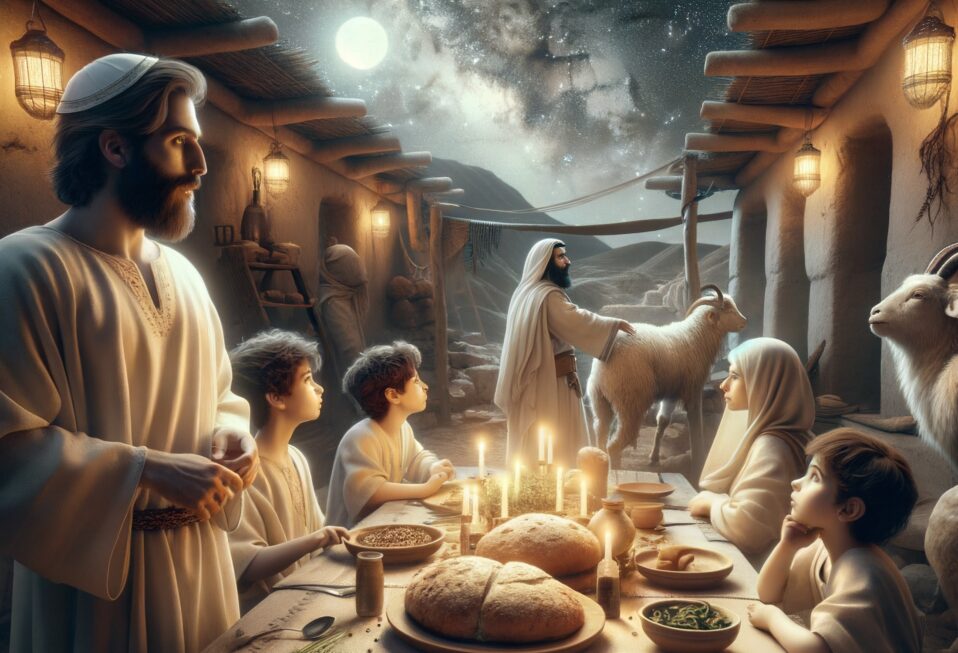
It was the night before freedom. All of the Israelites were huddled in their homes. They had been slaves in Egypt for 400 years. Moses had conveyed God’s instructions to kill a lamb for each household and then put the blood on the door posts of their homes. The Israelites were also commanded to roast the lamb and eat it—not leaving their homes until morning. That night, they waited in anticipation to see what would happen.

God struck the firstborn of every Egyptian home all the way up to Pharoh’s household that first Passover night, as the angel of death “passed over” the homes of the Israelites. The cry must have been agonizing, but the next day after 10 plagues and 400 years of slavery, the Israelites were finally free to leave Egypt under the leadership of Moses!

That’s the Biblical story of the Exodus, which is commemorated each year during Passover. In Exodus 13:8, God commanded the Jewish people to recount the story to their children year after year and to eat unleavened bread or what the Bible calls the bread of affliction for seven days.

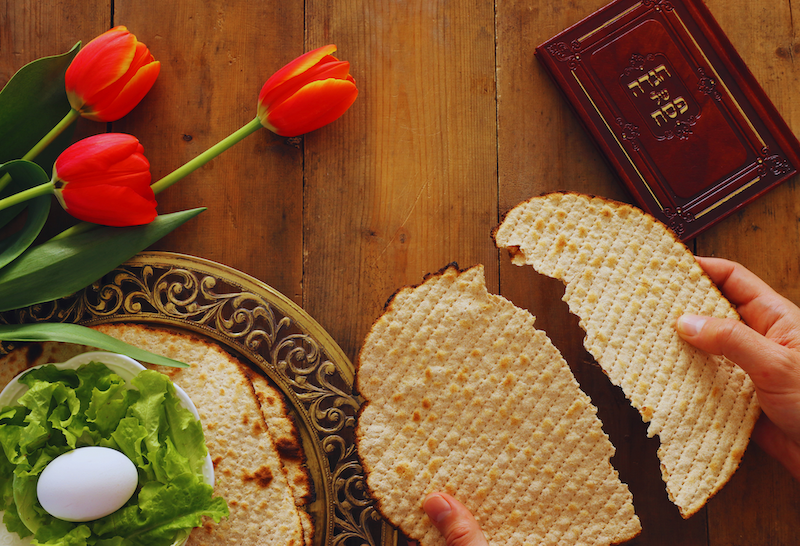
That’s what we call matzah (“unleavened bread”) today. Even though it’s made with flour (and no leavening agents), it must be mixed, rolled and shaped, and baked within 18 minutes to inhibit the rising.

For thousands of years, the Jewish people have told the story from the book of Exodus on the eve of Passover, “the fourteenth day of the first month” (Leviticus 23:5) in a special meal with symbolic food called a Seder, which means “order” in Hebrew. There are many traditions from all over the world, but the basic story is the same—God’s miraculous deliverance of the Jewish people against all odds.

Rabbi Levi Welton said that Passover, like all Jewish holidays, has a spiritual theme with applications for each person at any time.

“On Passover, the theme is freeing oneself from ‘personal slavery’ or self-limiting beliefs and transmitting a Jewish identity to the next generation. As the Talmud states in Tractate Pesachim 116b, ‘In each and every generation, a person is obligated to regard himself as though he actually left Egypt,’” says Welton.

Prior to Passover, Jewish people around the world remove all leaven from their homes. Varying traditions define leaven differently, but in general, it means that all bread, crackers, cake, cookies, noodles, and anything made with a leavening agent or flour are removed from the house. Many Jewish people even search every nook and cranny to make sure that not even a crumb remains.

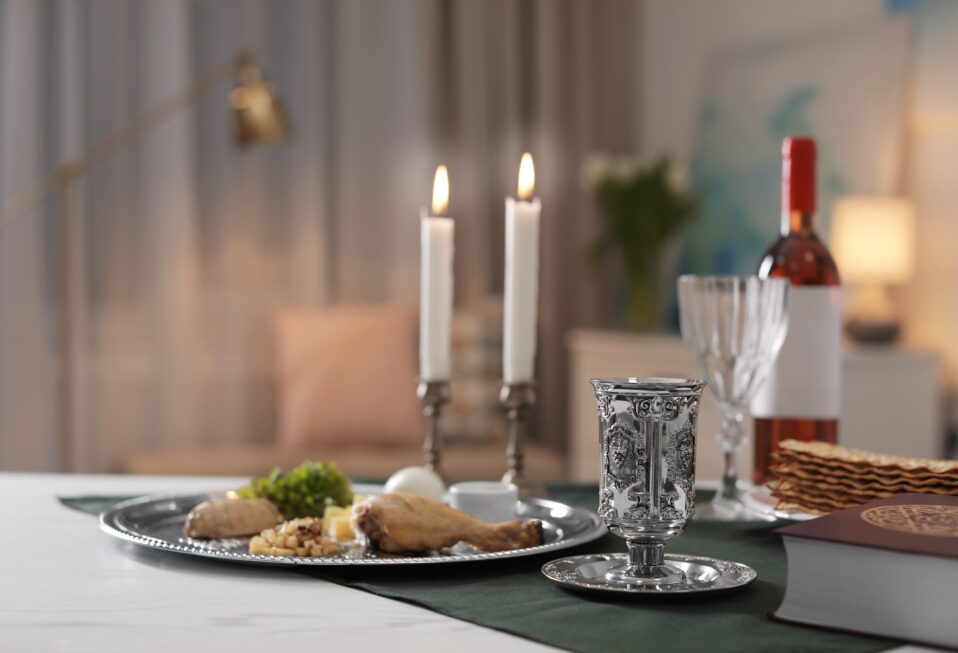
At the Seder, certain foods are placed on a Seder plate to symbolize parts of the story. A shank bone represents the sacrifice of the Passover lamb; an egg represents the cycle of life; maror (usually horseradish) symbolizes the bitterness of slavery; haroset (a sweet paste made of apples or dates) symbolizes the straw/mortar used to make the bricks in Egypt; and karpas (parsley or a vegetable) symbolize springtime and is dipped in salt water to symbolize the tears of the Hebrew slaves in Egypt; and matzah (“unleavened bread”) is also included on the table in a pouch or napkin.

Christians find deep meaning in celebrating the Passover Seder. Jesus’ Last Supper was actually a Passover meal, and the bread that He blessed and broke saying, “take this and eat it, for this is my body” was unleavened bread (Matthew 26:26).

Because of Jesus’ words during the Last Supper, many Christians to this day take communion with matzah bread. Some even say that its designs, with stripes and piercings, are symbolic of the suffering God’s Messiah, Jesus, endured when He was beaten and crucified. The fact that matzah is unleavened also represents His sinlessness.

Christians believe that Jesus was our Passover Lamb, sacrificed for the sins of the world. Many say that the cup Jesus raised was actually the third of four cups of wine that were drunk during Passover meals. The third cup is known as the Cup of Redemption, which fits perfectly with Jesus’ words: Each of you drink from it, for this is my blood, which confirms the covenant between God and his people. It is poured out as a sacrifice to forgive the sins of many” (Matthew 26:27-28). 

Passover and Resurrection Sunday (Easter) often occur the same time in March or April. Passover is celebrated for eight days, though only the first and last days are full holidays. In Israel, the Seder meal takes place on the first eve only and elsewhere in the world, Jewish people celebrate two consecutive Seder nights.

Julie Stahl is a correspondent for CBN News in the Middle East. A Hebrew speaker, she has been covering news in Israel full-time for more than 20 years. Julie’s life as a journalist has been intertwined with CBN—first as a graduate student in Journalism at Regent University; then as a journalist with Middle East Television (METV) when it was owned by CBN from 1989-91; and now with the Middle East Bureau of CBN News in Jerusalem since 2009. She is also an integral part of CBN News’ award-winning show, Jerusalem Dateline, a weekly news program providing a biblical and prophetic perspective to what is happening in Israel and the Middle East.

Read more